
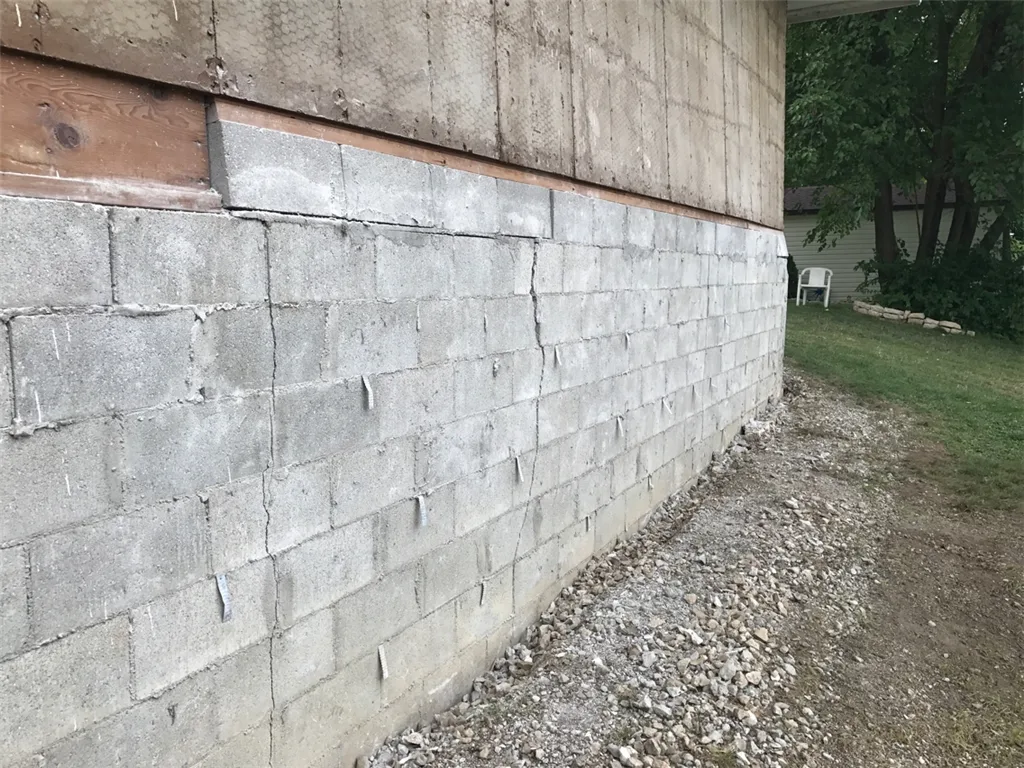
For many homeowners in Central Ohio, discovering a crack in the basement wall is a source of immediate stress. The instinct is often to reach for a DIY epoxy kit or call a handyman for a quick “patch” job. However, there is a critical tipping point where a wall moves beyond the help of simple reinforcements. When a concrete block wall loses its structural integrity, patching is no longer an option—it becomes a safety hazard.
At Spartan Wall Repair & Waterproofing, we pride ourselves on honesty. As a USMC veteran-owned company, our mission is to provide the most effective solution, not the most expensive one. But when a wall shows signs of total failure, a full or partial masonry rebuild is the only way to ensure your home remains standing for the next generation. Here is how to identify when your foundation has moved “beyond the patch.”

The Tipping Point: Identifying a Failing Block Wall
Concrete block (CMU) foundations are common in Columbus, but they are susceptible to the intense hydrostatic pressure of our local clay soils. While carbon fiber and steel beams are incredible tools for stabilization, they require a solid “host” wall to attach to. If the blocks themselves are disintegrating, there is nothing left to stabilize.
1. Severe Deflection (The 3-Inch Rule)
If a wall has bowed inward more than 3 inches, the center of gravity has likely shifted beyond the point of a simple “push-back” or reinforcement. At this stage, the mortar joints have often stretched and snapped, leaving the individual blocks “floating” rather than acting as a single unit.
2. Advanced Spalling and Crumbles
Spalling occurs when moisture enters the hollow cores of the concrete blocks and freezes, causing the face of the block to flake off or crumble. If the “face” of your foundation blocks can be scraped away with a screwdriver, the structural “skeleton” of the block is gone. A strap or beam cannot be anchored to a crumbling surface.
3. Shearing at the Footer
This is one of the most dangerous signs of failure. Shearing occurs when the bottom row of blocks is pushed inward, sliding across the concrete footer. This indicates that the connection between your house and its anchor point has been severed. Often, the only way to fix a sheared wall is to excavate, shore up the house, and rebuild the base.
The Spartan Rebuild Process: Military Precision
Rebuilding a foundation wall sounds like a nightmare for homeowners, but with the right team, it is a controlled, surgical process. We approach these high-stakes projects with 15+ years of masonry expertise and military-grade planning.
Shoring and Support
The first step in a rebuild is temporary shoring. We use heavy-duty steel jacks and beams to take the weight of your house off the failing wall. Your home remains perfectly safe and supported while the old masonry is removed.
Excavation and Removal
We excavate the soil on the exterior to relieve the pressure that caused the collapse in the first place. The damaged blocks are carefully removed, and the footer is cleaned and inspected for cracks. If the footer is damaged, we repair it before a single new block is laid.
The Rebuild
We lay new, high-strength concrete blocks, often reinforcing them with vertical rebar and solid concrete grout (slush-filling) to ensure this new wall is exponentially stronger than the one it replaced. We then apply a multi-layer waterproofing membrane to the exterior to ensure the “Enemy” (water) never gets back in.
Why Experience Matters in Masonry
Masonry is an art form that requires technical precision. In Central Ohio, many “waterproofing” companies only know how to install drains. They lack the masonry licenses and skills required to actually rebuild a structural wall. At Spartan, we are masons first. We understand mortar types, bond patterns, and load-bearing physics.
Frequently Asked Questions (FAQ)
Is a wall rebuild covered by insurance?
Typically, no. Most insurance policies exclude “earth movement” and “hydrostatic pressure.” This is why catching the problem while it can still be fixed with Steel Beams is so important. A rebuild is a last resort, but a necessary one when safety is at stake.
How long does a rebuild take?
Depending on the length of the wall, a full rebuild generally takes 5 to 10 business days. This includes excavation, shoring, masonry work, and backfilling.
Will my house “settle” after a rebuild?
Because we use adjustable shoring and high-strength materials, we minimize any movement. In many cases, the house is actually more level after the rebuild than it was when the wall was bowing.
Expert Evaluation When It Matters Most
If you think your wall is failing, don’t wait for a collapse. Dave and the team at Spartan Wall Repair & Waterproofing specialize in the most difficult structural masonry projects in Columbus. We provide owner-operated inspections and a Lifetime Transferable Warranty on our structural work.
Call 614-368-7612 today for a free, honest assessment of your foundation.
