If you own a home in Greater Columbus, your foundation operates under constant environmental stress. Central Ohio is notorious for its heavy illite and smectite clay soils, which act like a massive sponge during wet seasonal transitions. When these clay soils absorb water, they expand significantly and exert relentless lateral hydrostatic pressure against subterranean concrete block and poured foundation walls. Over time, this inward force causes masonry walls to deflect, crack, and bow inward.
Left unaddressed, a bowing basement wall threatens the structural integrity of your entire home, leading to stuck doors, uneven floors, and potential wall failure. When seeking a permanent structural repair, two primary engineered solutions dominate the industry: carbon fiber straps and steel I-beams. Understanding the differences, structural limits, and ideal applications of each will help you make an informed decision for your property.

Understanding Bowed Foundation Walls in Central Ohio
Foundation wall deflection rarely happens overnight. It typically begins with fine horizontal cracks running along the mortar lines of cinder block walls, usually two to three courses down from the top. As hydrostatic pressure builds during rainstorms and spring thaws, the wall begins pushing inward along that center crack.
Before selecting a repair method, a professional structural inspection is essential to measure total wall deflection (the distance the wall has moved inward from its original plumb position) and check for bottom-course shearing, where the bottom row of blocks slides inward off the concrete footing.
Option 1: Carbon Fiber Wall Reinforcement
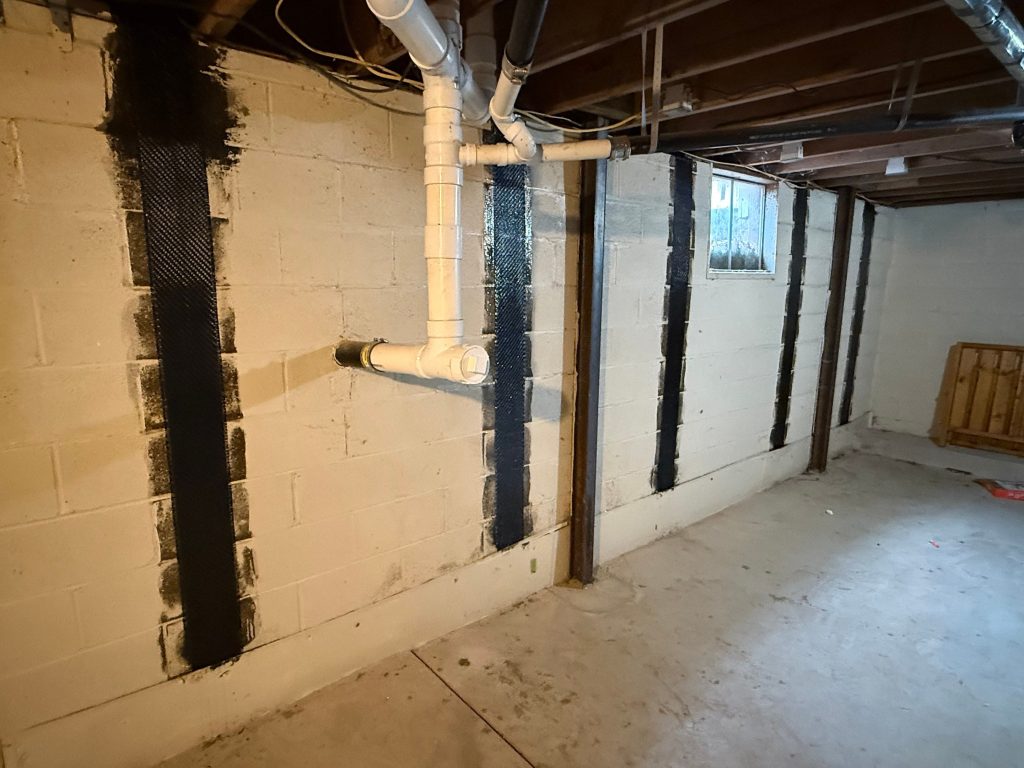
Carbon fiber reinforcement represents modern aerospace engineering applied to residential foundation repair. These ultra-thin, flexible woven straps are bonded directly to the interior face of the bowing wall using high-strength structural epoxy.
How Carbon Fiber Straps Work
Carbon fiber possesses incredible tensile strength—roughly ten times stronger than steel—making it virtually impossible to stretch or snap once cured. The installation process involves grinding the wall surface down to clean, bare masonry, applying epoxy resin, and embedding the carbon fiber strap vertically from the top wall plate down to the concrete floor slab. Top rim-joist anchors and bottom sill plate attachments lock the strap into the house frame.
Key Advantages of Carbon Fiber
- Low Profile: Straps are virtually flush against the wall (roughly 1/8-inch thick), allowing you to frame, insulate, and finish your basement without losing living space.
- Rapid Installation: Most residential projects can be completed in a single day with minimal jobsite noise or mess.
- Maintenance-Free: Carbon fiber will never rust, corrode, or deteriorate over time, and can be easily painted over.
Best Application
Carbon fiber straps are engineered for walls with minor to moderate bowing (less than 2 inches of total deflection) where the wall has not sheared at the footing or experienced severe block dislocation.
Option 2: Heavy-Duty Steel I-Beam Bracing
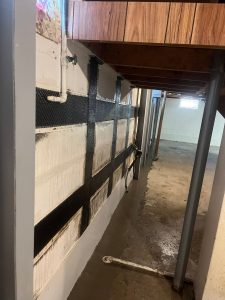
Steel I-beam stabilization is the traditional, battle-tested mechanical method for stabilizing severely compromised foundation walls. This system uses heavy-gauge structural steel posts placed vertically along the interior wall to resist lateral soil pressure.
How Steel I-Beams Work
Steel beams are custom-cut to match your basement wall height. The top of each beam is securely bolted to the heavy floor joists above using custom steel brackets. The bottom of the beam is anchored into the concrete floor slab or embedded directly into a hand-poured concrete footing trench. Once locked in place, the beams physically block the wall from moving any further inward.
Key Advantages of Steel I-Beams
- Maximum Structural Rigidity: Capable of resisting extreme hydrostatic forces that exceed carbon fiber limits.
- Addresses Shearing & Heavy Deflection: Can handle walls with severe bowing, staircase mortar cracking, or bottom-block shearing.
- Potential for Wall Realignment: In some cases, adjustable top brackets allow contractors to tighten and push the wall back toward plumb over time during dry seasons.
Best Application
Steel I-beams are required for severe wall deflection (exceeding 2 inches), walls experiencing bottom-course sliding, or structures where the masonry mortar joints have suffered significant deterioration.
Head-to-Head Comparison
| Feature | Carbon Fiber Straps | Steel I-Beams |
|---|---|---|
| Max Wall Deflection Handled | Up to ~2 Inches | 2+ Inches & Sheared Walls |
| Basement Space Footprint | Flush (~1/8-inch profile) | Protrudes 4 to 6 inches |
| Installation Time | 1 Day (Quiet & Clean) | 1 to 2 Days |
| Paintable / Concealable | Easily painted over directly | Requires stud framing to hide |
| Warranty Protection | Lifetime Transferable | Lifetime Transferable |
Which Solution Does Your Columbus Home Need?
Choosing between carbon fiber straps and steel I-beams isn’t a matter of preference—it’s a matter of structural engineering. Attempting to use carbon fiber on a wall with 3 inches of deflection or bottom shearing can lead to system failure, while installing heavy steel beams on a wall with minor 1-inch bowing may add unnecessary framing complexity if you plan to finish the basement.
At Spartan Wall Repair & Waterproofing, our Marine Corps veteran-led team brings precision, honesty, and over 15 years of hands-on experience to every foundation evaluation across Greater Columbus. We perform thorough laser-level measurements to determine exact deflection before recommending the proper, lifetime-warranted repair strategy.
Protect Your Home’s Structural Integrity Today
Noticed horizontal cracks or bowing basement walls in your home? Don’t wait for seasonal rains to worsen the damage. Contact Spartan Wall Repair & Waterproofing online or call (614) 368-7612 to schedule your free, no-pressure structural inspection and estimate!
