
For many homeowners in Marysville, Ohio, the crawlspace is one of the easiest areas of the home to overlook. Because it sits beneath the living space and is rarely visited, moisture and structural problems can develop without being immediately obvious.
Sometimes, the first warning signs appear upstairs.
Persistent musty odors, elevated indoor humidity, uneven floors, or a floor that feels unusually soft or bouncy underfoot may be associated with conditions inside the crawlspace.
These symptoms do not automatically mean that your home needs crawlspace encapsulation or structural repair. However, they are good reasons to inspect what is happening beneath the floor.
How Crawlspace Conditions Can Affect the Living Space Above

A crawlspace is not completely isolated from the rest of the home.
Air can move between the crawlspace and occupied areas through gaps and penetrations around plumbing, wiring, ductwork, framing, and other openings in the building envelope.
When a crawlspace remains damp, that air movement can carry musty odors and excess moisture into other areas of the home.
Understanding the Stack Effect
One factor that influences air movement through a house is known as the stack effect.
As warmer indoor air rises through a building and escapes through openings higher in the structure, lower portions of the home can draw replacement air through available gaps and penetrations.
In homes with crawlspaces, some of that air can come from beneath the first floor.
This is one reason moisture and odors inside a crawlspace should not necessarily be treated as an isolated problem. Improving moisture control and air sealing below the home can also help create a more controlled environment beneath the living space.
Why Vented Crawlspaces Can Develop Moisture Problems
Traditional crawlspaces were commonly constructed with foundation vents intended to provide outdoor airflow beneath the home.
However, ventilation does not guarantee that a crawlspace will remain dry.
During warm, humid Central Ohio weather, outdoor air entering a cooler crawlspace can raise relative humidity. If surfaces within the crawlspace are cool enough, moisture can also condense on building materials, pipes, ductwork, or other surfaces.
Exposed soil can provide another source of water vapor.
The result can be a damp environment that affects wooden framing and contributes to musty odors.
Crawlspace Warning: Persistent moisture, visible fungal growth, wood deterioration, standing water, or noticeable floor movement should be evaluated. The presence of one symptom alone does not determine the cause or the appropriate repair.
What Causes Bouncy or Sagging Floors?
A bouncy or uneven floor can have several possible causes, and not all of them originate with crawlspace moisture.
Floor movement may be related to:
- Excessive moisture affecting wooden framing
- Deteriorated or damaged joists or beams
- Inadequate support beneath the floor system
- Long framing spans
- Settlement or movement of existing supports
- Previous alterations to the structure
- Other structural or construction conditions
When wood remains exposed to excessive moisture for extended periods, it can become more susceptible to deterioration and decay.
If joists, beams, posts, or other supporting components are affected, homeowners may eventually notice changes in the floor above.
For that reason, a bouncy floor should be evaluated from below whenever the crawlspace is accessible.
Warning Signs Marysville Homeowners Should Watch For
Crawlspace problems do not always announce themselves with standing water. Some of the most useful clues may appear elsewhere in the house.
Persistent Musty Odors
A musty smell that repeatedly returns may indicate excess moisture somewhere in or beneath the home.
If the odor is strongest near the first floor, floor penetrations, registers, or crawlspace access, inspecting the crawlspace can help identify whether conditions below the home are contributing.
Uneven, Sagging, or Bouncy Floors
Floors that feel noticeably different from surrounding areas may indicate a problem with the supporting framing or structural supports beneath them.
The cause should be determined before selecting a repair method.
High Crawlspace Humidity
Consistently elevated humidity can create conditions that are unfavorable for wood framing and other building materials.
A professional evaluation can help identify the source of the moisture and determine whether drainage, vapor control, air sealing, dehumidification, or another measure is appropriate.
Condensation on Pipes, Ductwork, or Framing
Visible condensation indicates that moisture in the air is reaching surfaces cool enough for water to form.
Repeated condensation inside a crawlspace deserves attention because it can keep surrounding materials damp.
Visible Wood Deterioration
Discoloration, soft areas, damaged framing, or other visible changes in joists and beams should be evaluated before assuming that encapsulation alone will solve the problem.
Moisture control and structural repair address different parts of the crawlspace system and may need to be considered together.
Why Crawlspace Conditions Vary Across Marysville Homes
Not every crawlspace in Marysville has the same moisture or structural conditions.
Properties can differ in age, construction, grading, drainage, crawlspace height, foundation design, HVAC configuration, exposed soil, previous repairs, and how water moves around the home.
Even neighboring houses can experience different crawlspace conditions.
That is why a musty odor or bouncy floor should not automatically lead to a predetermined repair package. The source of the moisture and the condition of the structural framing should be evaluated first.
How Crawlspace Encapsulation Helps Control Moisture
Crawlspace encapsulation is designed to separate the interior crawlspace environment from exposed ground moisture and uncontrolled outdoor air.
A properly designed system can include several components depending on the conditions of the property.
Sealing the Ground With a Vapor Barrier
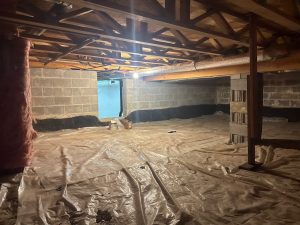
One of the most important components is a continuous vapor barrier installed over exposed soil.
The liner helps reduce the movement of ground moisture into the crawlspace. In an encapsulated system, seams, penetrations, edges, and connections should be addressed so the vapor barrier functions as a continuous moisture-control layer.
Spartan uses heavy-duty crawlspace liners, including reinforced 20-mil systems where appropriate, to create a durable barrier across the crawlspace floor and designated wall surfaces.
A thicker liner can provide additional durability and puncture resistance, but thickness alone does not determine whether an encapsulation system will perform correctly. Proper coverage, sealing, drainage, and moisture management are also important.
Managing Crawlspace Humidity
After uncontrolled moisture sources have been addressed and the crawlspace has been sealed appropriately, humidity still needs to be managed.
Depending on the design and conditions of the crawlspace, this may involve a properly sized dehumidifier or another approved method of conditioning or ventilation.
The objective is to maintain a more controlled environment beneath the home rather than allowing moisture conditions to fluctuate unchecked.
Addressing Drainage Before Encapsulation
Encapsulation should not be used to hide an active water problem.
If standing water, groundwater intrusion, poor exterior grading, drainage issues, or another bulk-water source is present, that condition should be identified and addressed as part of the overall moisture-control strategy.
Controlling water first helps the encapsulation system perform as intended.
When Structural Support May Also Be Needed
Encapsulation controls the crawlspace environment, but it does not automatically correct an existing structural problem.
If the floor system has inadequate support or structural components have moved or deteriorated, additional stabilization may be necessary.
Crawlspace Stabilizer Jacks
For certain floor-support problems, structural steel crawlspace jacks can provide supplemental support beneath beams or other appropriate structural members.
The exact installation depends on the existing framing, load path, support conditions, and cause of the floor movement.
When correctly designed and installed for the application, these supports can help stabilize affected areas of the floor system.
The goal should be appropriate stabilization based on the home’s actual conditions—not automatically forcing every floor back to a predetermined position.
Why Moisture Control and Structural Repair May Work Together
A Marysville homeowner with both a damp crawlspace and a bouncy floor may be dealing with two related issues:
1. The crawlspace environment: Excess moisture needs to be controlled.
2. The floor support system: Existing structural movement or deterioration may require stabilization or repair.
Addressing only one side of the problem may leave the other unresolved.
That is why a comprehensive crawlspace evaluation should consider both moisture conditions and the physical condition of the framing and supports.
What Spartan Evaluates in a Problem Crawlspace
When evaluating a crawlspace with moisture or floor-support concerns, relevant conditions may include:
- Visible moisture or standing water
- Crawlspace humidity
- Exposed soil
- Existing vapor barriers
- Foundation vents and openings
- Condition of joists and beams
- Existing posts and supports
- Visible floor deflection
- Drainage conditions
- Plumbing or other potential moisture sources
- Signs of previous repairs or alterations
These observations help determine whether the property may benefit from moisture control, encapsulation, structural stabilization, drainage improvements, or a combination of solutions.
Spartan Wall Repair & Waterproofing provides crawlspace encapsulation and repair services for homeowners throughout Columbus and surrounding Central Ohio communities.
Frequently Asked Questions About Crawlspace Encapsulation
Why are my floors bouncy near the center of the room?
Bouncy floors can have several causes.
The supporting joists or beams may have inadequate support, excessive span, deterioration, movement, or another structural condition. Long-term crawlspace moisture can also contribute to deterioration of susceptible wood components.
An inspection beneath the floor is the best way to determine what is causing the movement.
Should crawlspace vents stay open during the summer?
Not necessarily.
In humid weather, introducing warm, moisture-laden outdoor air into a cooler crawlspace can increase humidity and, under certain conditions, contribute to condensation.
Modern unvented crawlspace designs can instead use a continuous ground vapor retarder together with an appropriate method of moisture control or conditioning.
The correct approach depends on the construction and condition of the individual crawlspace.
Does crawlspace encapsulation help with musty odors?
It can when crawlspace moisture is contributing to the odor.
A properly designed encapsulation system reduces moisture entering from exposed soil and limits uncontrolled outdoor air infiltration. Other moisture sources should also be identified rather than assuming the crawlspace liner alone will eliminate every odor.
Is a 20-mil vapor barrier required for crawlspace encapsulation?
Not universally.
Vapor barriers are available in different materials and thicknesses, and applicable building requirements focus on factors such as vapor-retarder classification, coverage, continuity, and sealing.
Spartan may use a heavy-duty reinforced 20-mil liner where appropriate because its added thickness can provide durability and puncture resistance.
The correct material should be selected as part of the overall crawlspace system rather than based on thickness alone.
Will encapsulation fix a sagging floor?
Not by itself.
Encapsulation is primarily a moisture-control strategy. If beams, joists, posts, or other structural components require stabilization or repair, that work must be evaluated separately.
Some crawlspaces require both structural stabilization and moisture control.
Does every damp crawlspace need a dehumidifier?
No single solution is appropriate for every crawlspace.
Humidity control depends on the design of the encapsulation system, existing moisture sources, drainage, air movement, and conditions within the home.
Where dehumidification is used, the equipment should be appropriately sized for the space and installation.
Concerned About Musty Smells or Bouncy Floors in Your Marysville Home?
Persistent crawlspace moisture can affect more than the space beneath your home.
If you have noticed musty odors, elevated humidity, visible moisture, uneven flooring, or a floor that feels unusually bouncy, inspecting the crawlspace can help identify what is happening beneath the living area.
Spartan Wall Repair & Waterproofing provides crawlspace encapsulation, moisture-control, and structural repair solutions for homeowners in Marysville and surrounding Central Ohio communities.
Our team can evaluate the condition of the crawlspace and help determine whether encapsulation, drainage improvements, structural stabilization, or a combination of solutions is appropriate for your home.
Contact Spartan Wall Repair & Waterproofing to schedule a crawlspace evaluation in Marysville, Ohio.
