If you own a home in Central Ohio, you’ve likely noticed the unique behavior of our soil. The heavy, expansive clay that surrounds our foundations acts like a sponge—swelling when it’s wet and shrinking during our humid summer droughts. This constant “push and pull” creates immense hydrostatic pressure, eventually forcing basement walls to bow, lean, or crack.
When you discover your foundation wall is no longer plumb, the mission is clear: stabilize the structure immediately. But which “shield” is right for your home? At Spartan Wall Repair & Waterproofing, we specialize in the two industry-standard solutions: Adjustable Steel I-Beams and Carbon Fiber Straps. Here is how to choose the right reinforcement for your specific battle against Ohio’s soil.

The Spartan Strategy: Analyzing Your Wall’s Deflection
The choice between steel and carbon fiber isn’t about which material is “better” in a vacuum—it’s about the severity of the damage. In the foundation world, we measure this by deflection (how far the wall has moved inward from its original vertical position).
1. Carbon Fiber Straps: The Low-Profile Powerhouse
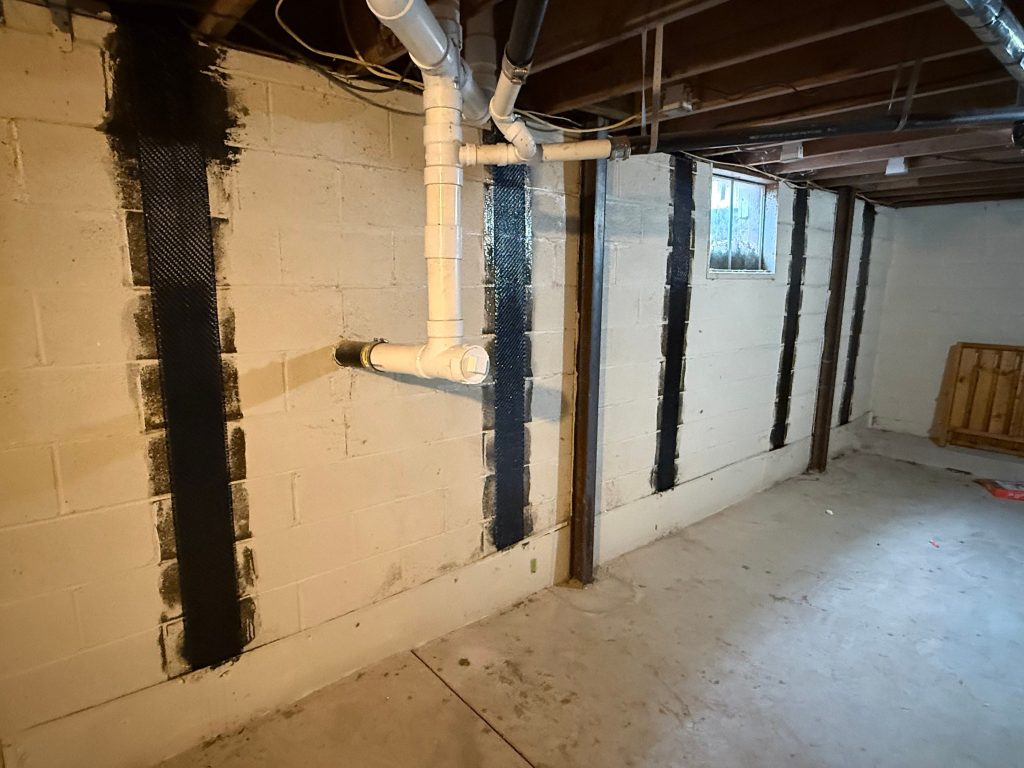
Carbon fiber is a high-tech material that is actually stronger than steel in terms of tensile strength. We use the Wall Armor system, which consists of carbon-reinforced straps bonded directly to your basement wall with industrial-grade epoxy.
- Best For: Walls with minor to moderate bowing (typically less than 2 inches of deflection).
- The Benefit: It is virtually invisible. Once installed, the straps are only about a fraction of an inch thick. You can paint over them or frame a stud wall directly against them without losing square footage.
- Installation: Fast and non-invasive. Most carbon fiber “missions” are completed in a single day with no digging required.
2. Adjustable Steel I-Beams: The Heavy-Duty Guard
When a wall has shifted significantly, it needs more than just a surface bond—it needs a rigid structural skeleton. Our zinc-plated steel I-Beams are anchored into the floor and bolted to the heavy joists above.
- Best For: Severe bowing (over 2 inches), shearing at the footer, or walls that have shifted at the top.
- The Benefit: Strength and adjustability. Unlike carbon fiber, which “freezes” a wall in its current state, steel beams can sometimes be tightened over time to help push a wall back toward its original position.
- Installation: Requires slightly more space. The beams protrude about 4 inches from the wall, which is an important consideration if you plan to finish your basement.
Side-by-Side Comparison: Ohio Homeowner’s Guide
| Feature | Carbon Fiber (Wall Armor) | Steel I-Beams |
|---|---|---|
| Max Deflection | Up to 2 Inches | 2+ Inches / Severe Failure |
| Basement Space | Zero footprint lost | Loses ~4 inches of wall depth |
| Aesthetics | Paintable & easily hidden | Visible vertical beams |
| Adjustability | Permanent “Freeze” | Can be tightened/adjusted |
| Ohio Soil Performance | Excellent for clay expansion | Superior for high-pressure zones |
Why Veterans Choose Spartan for Foundation Defense

As a USMC veteran-owned company, Spartan Wall Repair doesn’t believe in “upselling” a homeowner into a more expensive repair if a simpler one is more effective. We approach every basement with military discipline: we identify the threat, assess the structural integrity, and deploy the most cost-effective solution that carries a Lifetime Transferable Warranty.
Whether you’re in a historic home in German Village with shifting stone or a modern build in Dublin with cracking blocks, we provide factory-direct pricing and an honest, no-pressure inspection process.
Frequently Asked Questions (FAQ)
Does carbon fiber really hold as well as steel?
Yes. In terms of stopping a wall from moving further, carbon fiber is incredibly effective because it doesn’t stretch. However, if the wall has already moved so far that its center of gravity is compromised, steel beams are necessary to provide the physical mass required to hold the house up.
Will these repairs affect my home’s resale value?
On the contrary, they protect it. A bowing wall is a massive “red flag” for home inspectors and banks. By installing a warranted system from Spartan, you turn a structural liability into a certified, stable asset that can be passed on to the next buyer.
How much does foundation wall stabilization cost in Columbus?
While every home is different, typical reinforcement projects in 2026 range from $4,000 to $12,000. Factors include the number of beams or straps needed and the ease of access to your joists. Spartan offers free, transparent estimates with no hidden deposits.
Ready to fortify your foundation? Don’t wait for the next Ohio rainstorm to turn a small crack into a major collapse. Contact Spartan Wall Repair & Waterproofing today for a Free Structural Inspection.
Call Dave at 614-368-7612 or Schedule Online.
