

Discovering a horizontal crack along your basement wall is every Columbus homeowner’s nightmare. In Central Ohio, expansive clay soils absorb heavy rainfall and swell dramatically, exerting immense lateral pressure against concrete block and poured foundation walls. Over time, this hydrostatic force pushes foundation walls inward—causing them to bow, lean, or shear at the floor joint.
When wall deflection exceeds two inches or shows signs of structural displacement, cosmetic patches and lightweight carbon fiber straps are no longer sufficient. To permanently stabilize your home’s foundation and preserve its equity, you need a heavy-duty mechanical repair system: Steel I-Beams or Plate Wall Anchors.
Here is a detailed structural comparison to help you understand which system is best suited to fix your bowed basement wall in Greater Columbus.
1. Steel I-Beam Foundation Wall Stabilization
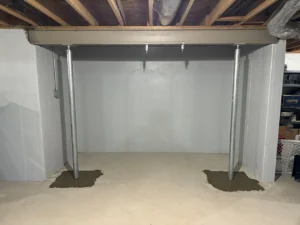
Steel I-beam reinforcement is one of the most trusted and non-invasive methods for stabilizing severely bowed basement walls throughout Franklin and Delaware Counties.
How It Works
Heavy-duty structural steel I-beams are custom-cut to match the height of your basement wall. Each beam is set vertically tight against the face of the bowed wall. The bottom of the beam is anchored firmly into the concrete basement floor slab, while the top is secured directly to the wooden floor joists above using engineered steel bracket assemblies. This creates a solid vertical brace that transfers soil pressure across the entire structural frame of the house.
Key Advantages
- Zero Exterior Excavation: All work is completed entirely from inside the basement, leaving your lawn, patio, and landscaping completely untouched.
- Immediate Structural Relief: Stoppage of inward movement happens the moment the beams are anchored in place.
- Ideal for Tight Lots: Perfect for urban Columbus neighborhoods like Clintonville, Grandview, or German Village where narrow lot lines restrict heavy machinery access.
2. Earth Plate Wall Anchor Systems
Wall anchors rely on stable, undisturbed soil outside your basement perimeter to counteract hydrostatic pressure and hold foundation walls in place.
How It Works
To install wall anchors, a small hole is drilled through your basement wall. A technician drives a threaded steel rod horizontally out into the yard, extending past the backfill zone (typically 12 to 15 feet from the foundation). An anchor plate is buried deep in undisturbed lawn soil, and an interior wall plate is attached to the rod inside your basement. The rod is then tightened to anchor the wall into position.
Key Advantages
- Potential to Straighten Walls: Unlike passive bracing, wall anchors can be tightened over time during dry seasons to incrementally pull bowed walls back toward plumb.
- Minimal Interior Footprint: Low-profile interior wall plates sit almost flat against the basement masonry.
Comparing Structural Repair Systems
| Feature / Criteria | Steel I-Beams | Plate Wall Anchors |
|---|---|---|
| Primary Function | Permanent internal wall bracing & deflection stoppage | Anchoring into exterior yard soil with wall-straightening potential |
| Exterior Lawn Excavation | None (100% internal installation) | Minimal (Small excavation pits required in yard) |
| Best For | Property line limits, paved driveways, severe lower-wall shearing | Open yard space available (12–15+ ft clearance from foundation) |
| Installation Time | 1 to 2 Days | 1 to 2 Days |
Why DIY Repairs & Patching Fail
Attempting to fix a bowing basement wall with off-the-shelf hydraulic cement, mortar, or surface waterproof paint only conceals a dangerous structural issue. Hydrostatic pressure continues to build behind the wall, eventually leading to catastrophic wall failure or home buyer inspection rejections during real estate transactions. Permanent foundation stabilization requires calculated load-bearing engineering.

Frequently Asked Questions
How do I know if my bowed basement wall needs steel beams instead of carbon fiber?
If your basement wall bows inward by more than 2 inches, or if the bottom course of concrete blocks has sheared inward from the floor slab, carbon fiber straps alone are no longer structurally sufficient. Steel I-beams or wall anchors are required to resist heavy lateral clay soil loads.
Will installing steel I-beams ruin my plans to finish the basement?
Not at all. Steel I-beams are installed tight against the masonry wall. When you are ready to finish your basement, wood stud framing can easily be built around or over the beams, completely hiding them behind drywall.
Does Spartan Wall Repair offer a warranty on structural beam installations?
Yes. Every structural wall repair installed by Spartan Wall Repair & Waterproofing is backed by our Lifetime Transferable Warranty, protecting your home’s resale value for decades to come.
Protect Your Columbus Home From Structural Failure
Don’t let bowed basement walls compromise your home’s safety and value. Owned and operated by a United States Marine Corps veteran, Spartan Wall Repair & Waterproofing delivers discipline, precision, and lifetime structural solutions across Greater Columbus and Central Ohio.
Call (614) 368-7612 today or visit us online to schedule your free, no-obligation on-site structural inspection.
